There used to be a tiny, sun-faded panadería on Avenida Revolución in Tijuana that made the most incredible pan de muerto. When they closed their doors three years ago—just a handwritten “Cerrado” sign taped to the door one morning—I genuinely felt a little hollow inside. I mean, that bread was more than bread. It was the reason I looked forward to November first every single year. After twelve tries—honestly, the first four were dense little bricks—I finally got it. This wholesome version of Mexican pan de muerto captures that exact memory: the orange-scented softness, the slight crunch of sugar on top, and the way it feels like a hug from someone you miss. You know that feeling when you bite into something and it immediately transports you somewhere? That’s this bread. It took me a while to figure out the balance between keeping it traditional and making it a little better for you, but let me tell you, this recipe is the one.
Why You’ll Love This Recipe
This wholesome Mexican pan de muerto isn’t just another holiday bread recipe. It’s the result of many kitchen experiments, a few flour clouds, and one particularly memorable batch where I forgot the orange zest entirely. Here’s why this one earns a permanent spot in your fall baking rotation:
- Made with Real Ingredients: No weird preservatives or shortening here. This version uses butter and whole wheat pastry flour for a bread that feels nourishing, not heavy.
- Perfect for Day of the Dead: Whether you’re building an ofrenda or just want a beautiful, meaningful bread to share with family, this pan de muerto fits the occasion beautifully.
- Surprisingly Easy Dough: If you’ve been scared of yeasted breads, this one is forgiving. The dough is soft, not sticky, and rises reliably even on cool kitchen days.
- That Authentic Flavor: The orange blossom water and fresh zest combination is absolutely non-negotiable—and it’s what makes this taste like the real deal.
- Healthier Twist: By swapping in some whole grain flour and reducing the sugar just a bit, you get a bread that feels good to eat without sacrificing that pillowy, celebratory texture.
This isn’t just another version of pan de muerto. It’s the one that makes you close your eyes after the first bite. The one that tastes like early morning panadería visits and the scent of marigolds. It’s comfort food reimagined—wholesome, soul-soothing, and absolutely worth the small effort.
What Ingredients You Will Need
This recipe uses simple, wholesome ingredients to deliver that iconic orange-kissed flavor and tender crumb without the fuss of specialty additives. Most of these are pantry staples, which makes this a really approachable bake.
- For the Dough:
- 3 ½ cups (440g) all-purpose flour or whole wheat pastry flour – I like King Arthur for consistent results, but any good brand works. The whole wheat pastry flour gives a lovely nuttiness without making the bread dense.
- ½ cup (100g) granulated sugar – Just enough sweetness. You can reduce to ⅓ cup if you prefer a less sweet bread.
- 1 packet (2 ¼ tsp) active dry yeast – I use Red Star, but any brand works. Make sure it’s fresh!
- ½ cup (120ml) warm whole milk – About 110°F. You can use oat milk for a dairy-free version.
- ¼ cup (60ml) warm water – Same temperature as the milk.
- 3 large eggs, at room temperature – This is important for a smooth dough. Cold eggs can shock the yeast.
- ¼ cup (60g) unsalted butter, softened – Let it sit out for an hour. I’ve used vegan butter here too, and it worked fine.
- 2 tsp orange blossom water – This is the secret ingredient. Find it at Latin markets or online. It’s worth hunting for.
- Zest of 2 large oranges – Freshly zested, not the dried stuff. This is where the bright flavor lives.
- 1 tsp vanilla extract
- ½ tsp salt
- For the Topping:
- ¼ cup (60g) unsalted butter, melted
- ½ cup (100g) granulated sugar – Mixed with 1 tsp orange zest for extra flavor. Some people use cinnamon sugar, but I prefer the pure orange version.
For the orange blossom water, look for brands like Cortas or Al Wadi—they’re reliable and not too expensive. If you can’t find it, you can use 1 tablespoon of fresh orange juice plus an extra ½ teaspoon of zest, but honestly, the orange blossom water makes it taste like the real panadería version.
Equipment Needed
You don’t need a fancy bakery setup for this wholesome pan de muerto. Here’s what you’ll need:
- Stand mixer with dough hook: Totally optional, but it makes kneading effortless. I used a KitchenAid for years, but a sturdy wooden spoon and some elbow grease work just as well.
- Large mixing bowl: Glass or ceramic is best because it holds heat well.
- Baking sheet: A standard half-sheet pan lined with parchment paper.
- Plastic wrap or a clean kitchen towel: For covering the dough while it rises.
- Sharp knife or bench scraper: For shaping those iconic bone shapes on top.
- Pastry brush: For applying the melted butter before the sugar coating.
- Cooling rack: Essential for keeping the bottom from getting soggy.
If you don’t have a stand mixer, just knead the dough on a lightly floured surface for about 10 minutes. It’s a little workout, but honestly, it’s kind of meditative. I’ve done it both ways, and the hand-kneaded bread always feels a little more special.
Preparation Method
- Activate the yeast: In a small bowl, combine the warm milk, warm water, and 1 tablespoon of the sugar. Sprinkle the yeast on top and let it sit for 5-10 minutes until it’s foamy. If it doesn’t foam, your yeast might be dead—start over with fresh yeast.
- Mix the dry ingredients: In a large bowl or the bowl of your stand mixer, whisk together the flour, remaining sugar, and salt. Make a well in the center.
- Combine the wet ingredients: In a separate bowl, whisk together the eggs, orange blossom water, orange zest, and vanilla extract. Pour this mixture into the well of dry ingredients, then add the foamy yeast mixture.
- Knead the dough: Using the dough hook on low speed, mix until a shaggy dough forms. Add the softened butter, one tablespoon at a time, mixing well after each addition. Increase speed to medium and knead for 8-10 minutes, or until the dough is smooth, elastic, and pulls away from the sides of the bowl. If kneading by hand, turn the dough onto a floured surface and knead for 10-12 minutes. The dough should be soft and slightly tacky but not sticky.
- First rise: Shape the dough into a ball and place it in a lightly oiled bowl. Cover with plastic wrap or a damp towel and let it rise in a warm, draft-free place for 1 ½ to 2 hours, or until doubled in size. I like to put it in my oven with the light on—it’s the perfect cozy spot.
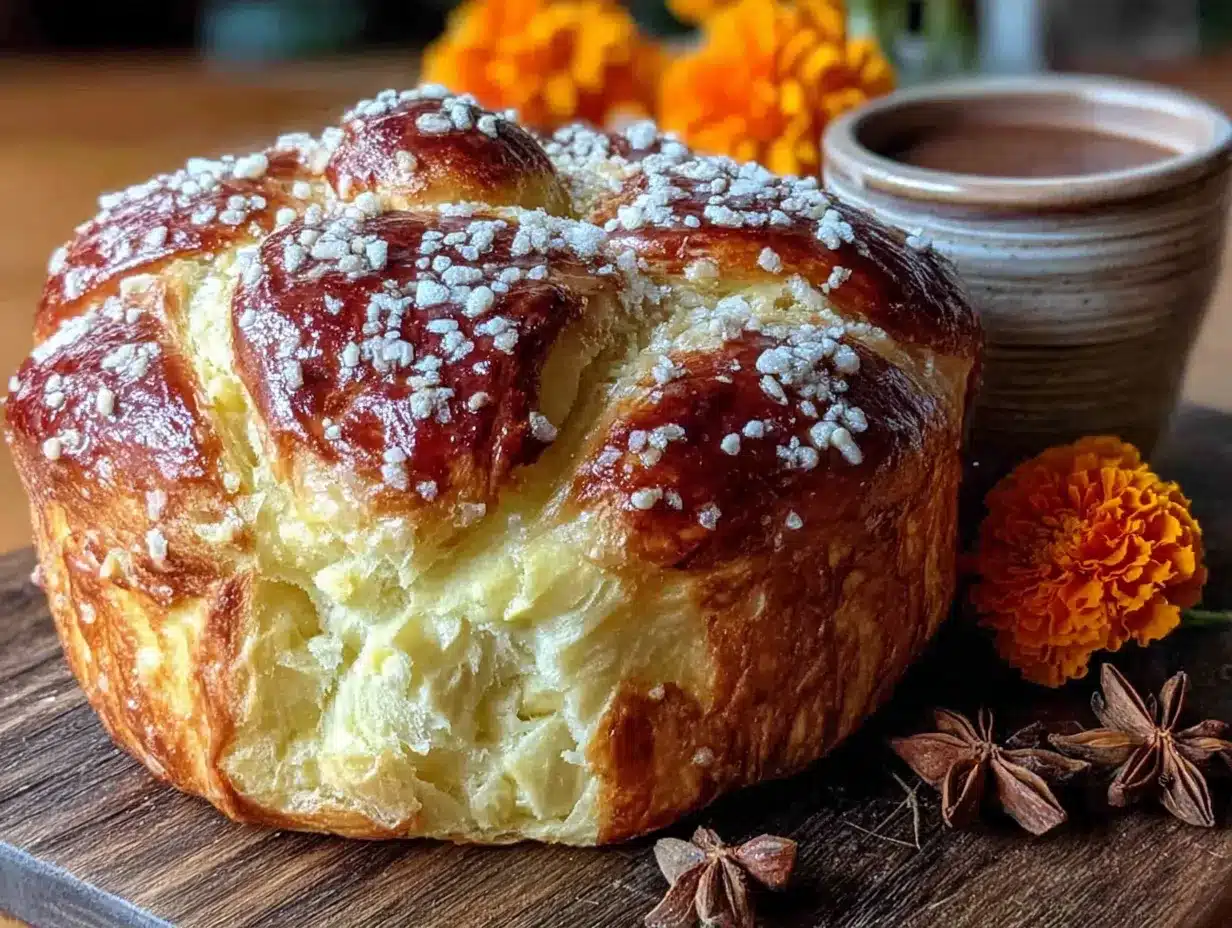
- Shape the bread: Punch down the dough gently to release the air. Turn it out onto a lightly floured surface. Divide the dough into two parts: one larger piece (about ⅔ of the dough) for the base, and one smaller piece for the decorations. Shape the large piece into a round ball and place it on your prepared baking sheet. From the smaller piece, roll out a few long ropes for the “bones” and a small ball for the top “skull” knot. Traditionally, pan de muerto has four or five bone shapes radiating from the center. Place them on top of the round loaf, pressing gently to adhere.
- Second rise: Cover the shaped loaf loosely with plastic wrap and let it rise for another 45 minutes to 1 hour, or until it looks puffy and almost doubled.
- Bake: Preheat your oven to 350°F (175°C). Bake the bread for 25-30 minutes, or until the top is deep golden brown and the loaf sounds hollow when tapped on the bottom. If the top is browning too quickly, tent it loosely with foil halfway through.
- Finish with the topping: Let the bread cool on the baking sheet for 5 minutes, then transfer to a cooling rack. While it’s still warm, brush the entire surface with melted butter. Sprinkle generously with the orange-scented sugar. Let it cool completely before slicing—if you can wait that long.
The dough should feel soft and pillowy after the second rise, and the orange scent will fill your whole kitchen. Honestly, that’s my favorite part of the whole process.
Cooking Tips & Techniques
I’ve made this wholesome pan de muerto enough times to have a few hard-won lessons. Here’s what I wish someone had told me:
- Don’t skip the orange blossom water. I tried making this once with just orange juice and zest, and it was good, but it wasn’t *that* bread. The orange blossom water adds a floral, almost perfumed note that’s essential for authenticity. It’s like the difference between a good vanilla cake and one made with vanilla extract from a fancy bottle.
- Temperature matters more than you think. If your milk and water are too hot, they’ll kill the yeast. Too cold, and the yeast won’t activate. I use a kitchen thermometer, but if you don’t have one, the liquid should feel like warm bath water—not hot, not cool.
- The dough might seem sticky at first. Don’t panic and add more flour. Keep kneading, and the gluten will develop, making the dough smooth and manageable. I’ve definitely added too much flour before, and the bread came out dense. Trust the process.
- Let it cool before slicing. I know it’s tempting to cut into that warm, buttery loaf, but the crumb needs time to set. If you slice it too soon, it’ll be gummy. Give it at least 30 minutes on the cooling rack.
- Multitask wisely. While the dough is rising for the first time, you can zest your oranges, measure your sugar for the topping, and clean up your workspace. It makes the whole process feel less overwhelming.
Variations & Adaptations
This wholesome pan de muerto is pretty flexible. Here are a few ways to make it your own:
- Gluten-Free Version: Substitute the all-purpose flour with a good 1:1 gluten-free flour blend that contains xanthan gum. I’ve used Bob’s Red Mill with decent results. The texture will be a little more cake-like, but the flavor is still wonderful.
- Vegan Adaptation: Use oat milk or almond milk in place of whole milk, and substitute the butter with a high-quality vegan butter like Miyoko’s. For the eggs, use 3 flax eggs (3 tablespoons ground flaxseed mixed with 9 tablespoons water, left to thicken for 10 minutes). The bread will be slightly denser but still delicious.
- Spiced Version: Add 1 teaspoon of ground cinnamon and ½ teaspoon of ground anise seed to the flour mixture. This gives the bread a warm, cozy flavor that’s perfect for fall. I tried this one year when I had extra anise from another recipe, and it was a hit.
- Chocolate Swirl: After the first rise, roll the dough out into a rectangle, spread with a thin layer of dark chocolate chips, and roll it up before shaping into a round loaf. The chocolate melts into the bread during baking, creating little pockets of richness.
- Mini Loaves: Instead of one large loaf, divide the dough into 8-10 small rounds and shape each one with tiny bone decorations. Reduce the baking time to 15-18 minutes. These are perfect for sharing or for giving as gifts.
Serving & Storage Suggestions
This wholesome pan de muerto is best served slightly warm, when the butter and sugar topping is still a little melty and the orange aroma is at its peak. I love it with a cup of Mexican hot chocolate or a simple café de olla. It’s also wonderful with a side of fresh fruit for breakfast the next morning.
For storage, wrap the cooled bread tightly in plastic wrap or store it in an airtight container at room temperature. It will stay fresh for 3-4 days. The flavors actually deepen after a day or two—the orange becomes more mellow and the bread gets even softer.
To reheat, wrap a slice in foil and warm it in a 300°F oven for 5-7 minutes. You can also microwave it for 15-20 seconds, but the oven method is better for keeping that crusty exterior. I don’t recommend freezing this bread because the texture can become a bit dry, but if you must, wrap it tightly in plastic wrap and then foil, and freeze for up to 2 months. Thaw at room temperature and reheat before serving.
The bread is also lovely when served as part of an ofrenda, alongside marigolds, photos, and other offerings. It’s a beautiful way to honor loved ones while sharing something delicious with the living.
Nutritional Information & Benefits
Per slice (based on 12 slices):
- Calories: 285
- Fat: 12g
- Carbohydrates: 38g
- Fiber: 2g
- Sugar: 14g
- Protein: 6g
This wholesome version of pan de muerto is a healthier take on a traditional favorite. The whole wheat pastry flour adds fiber and nutrients, while the orange zest and orange blossom water provide a natural sweetness that allows us to use less sugar. The eggs contribute high-quality protein, and the butter, while indulgent, is used in moderation. This bread is a wonderful way to enjoy a cultural tradition without the guilt. It’s also naturally nut-free and can easily be made dairy-free or vegan with the substitutions mentioned above. Always check your labels if you have specific allergies, as some brands of orange blossom water may contain traces of other ingredients.
Conclusion
This wholesome Mexican pan de muerto is more than just a recipe—it’s a little piece of tradition that you can bring into your own kitchen. It’s the bread that made me fall in love with Day of the Dead celebrations, and I hope it becomes a beloved part of your fall baking, too. Whether you’re making it for an ofrenda, a family gathering, or just because you want a beautiful, orange-scented loaf, this one is worth every minute of rising time.
I’d love to hear how yours turns out! Did you try any of the variations? Did your kitchen smell like a panadería? Drop a comment below and share your experience. And if you’re looking for more wholesome Mexican-inspired recipes, check out our Mexican hot chocolate cookies or healthy tres leches cake for more delicious, feel-good treats. Happy baking, and ¡Feliz Día de los Muertos!
Frequently Asked Questions
Can I make this pan de muerto ahead of time?
Yes! You can prepare the dough through the first rise, then punch it down, wrap it tightly, and refrigerate it for up to 24 hours. When you’re ready to bake, let it come to room temperature and proceed with shaping and the second rise. The flavor actually improves with a longer, slow rise in the fridge.
Why didn’t my dough rise?
There are a few common culprits. Your yeast might be expired, your liquid might have been too hot (killing the yeast) or too cold (not activating it), or your kitchen might be too drafty. Try placing the dough in a warm spot, like an oven with just the light on, and make sure your yeast is fresh. If all else fails, start over with new yeast.
Can I use all-purpose flour instead of whole wheat pastry flour?
Absolutely. You can use 100% all-purpose flour for a lighter, fluffier texture. The whole wheat pastry flour adds a subtle nuttiness and more fiber, but the bread will still be delicious with all-purpose. Just note that the color will be a little paler.
What can I use instead of orange blossom water?
If you can’t find orange blossom water, you can substitute it with 1 tablespoon of fresh orange juice mixed with an extra ½ teaspoon of orange zest. The flavor won’t be quite as floral, but it will still be very orange-forward and delicious. Some people also use a splash of orange liqueur like Grand Marnier for a boozy twist.
How do I get the perfect bone shapes on top?
Roll the dough for the decorations into ropes about ½ inch thick. For the bones, cut the ropes into 4-inch pieces, then roll each piece into a slightly thinner rope. Place one piece horizontally across the top of the loaf, then use your finger to press a small indent in the center to create the “joint” of the bone. Repeat with 4-5 pieces radiating from the center. It takes a little practice, but even imperfect shapes look beautiful and rustic.
Pin This Recipe!
Wholesome Mexican Pan de Muerto: Easy Day of the Dead Bread

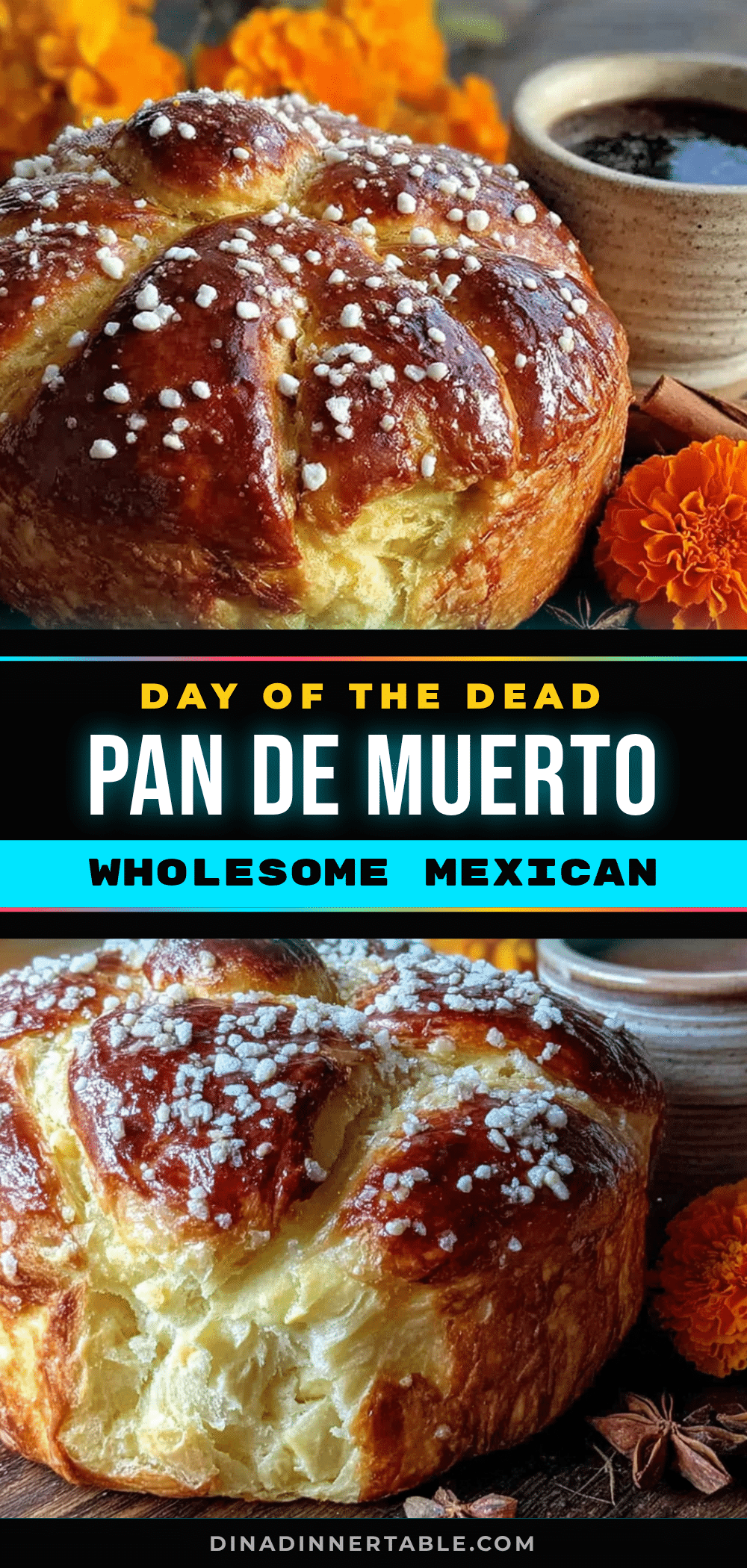
This wholesome version of Mexican pan de muerto captures the orange-scented softness, the slight crunch of sugar on top, and the way it feels like a hug from someone you miss. It’s comfort food reimagined—wholesome, soul-soothing, and absolutely worth the small effort.
- Prep Time: 30 minutes
- Cook Time: 30 minutes
- Total Time: 3 hours 30 minutes
- Yield: 12 servings 1x
- Category: Bread
- Cuisine: Mexican
Ingredients
- 3 ½ cups (440g) all-purpose flour or whole wheat pastry flour
- ½ cup (100g) granulated sugar
- 1 packet (2 ¼ tsp) active dry yeast
- ½ cup (120ml) warm whole milk (about 110°F)
- ¼ cup (60ml) warm water (about 110°F)
- 3 large eggs, at room temperature
- ¼ cup (60g) unsalted butter, softened
- 2 tsp orange blossom water
- Zest of 2 large oranges
- 1 tsp vanilla extract
- ½ tsp salt
- ¼ cup (60g) unsalted butter, melted (for topping)
- ½ cup (100g) granulated sugar (for topping)
- 1 tsp orange zest (for topping)
Instructions
- Activate the yeast: In a small bowl, combine the warm milk, warm water, and 1 tablespoon of the sugar. Sprinkle the yeast on top and let it sit for 5-10 minutes until it’s foamy.
- Mix the dry ingredients: In a large bowl or the bowl of your stand mixer, whisk together the flour, remaining sugar, and salt. Make a well in the center.
- Combine the wet ingredients: In a separate bowl, whisk together the eggs, orange blossom water, orange zest, and vanilla extract. Pour this mixture into the well of dry ingredients, then add the foamy yeast mixture.
- Knead the dough: Using the dough hook on low speed, mix until a shaggy dough forms. Add the softened butter, one tablespoon at a time, mixing well after each addition. Increase speed to medium and knead for 8-10 minutes, or until the dough is smooth, elastic, and pulls away from the sides of the bowl. If kneading by hand, turn the dough onto a floured surface and knead for 10-12 minutes.
- First rise: Shape the dough into a ball and place it in a lightly oiled bowl. Cover with plastic wrap or a damp towel and let it rise in a warm, draft-free place for 1 ½ to 2 hours, or until doubled in size.
- Shape the bread: Punch down the dough gently. Turn it out onto a lightly floured surface. Divide the dough into two parts: one larger piece (about ⅔ of the dough) for the base, and one smaller piece for the decorations. Shape the large piece into a round ball and place it on your prepared baking sheet. From the smaller piece, roll out a few long ropes for the ‘bones’ and a small ball for the top ‘skull’ knot. Place them on top of the round loaf, pressing gently to adhere.
- Second rise: Cover the shaped loaf loosely with plastic wrap and let it rise for another 45 minutes to 1 hour, or until puffy and almost doubled.
- Bake: Preheat your oven to 350°F (175°C). Bake the bread for 25-30 minutes, or until the top is deep golden brown and the loaf sounds hollow when tapped on the bottom. If the top is browning too quickly, tent it loosely with foil halfway through.
- Finish with the topping: Let the bread cool on the baking sheet for 5 minutes, then transfer to a cooling rack. While still warm, brush the entire surface with melted butter. Sprinkle generously with the orange-scented sugar. Let cool completely before slicing.
Notes
Don’t skip the orange blossom water—it’s essential for authentic flavor. Temperature matters: milk and water should be about 110°F. The dough might seem sticky at first; keep kneading and don’t add extra flour. Let the bread cool completely before slicing to avoid a gummy texture. For a dairy-free version, use oat milk and vegan butter. For a vegan version, use flax eggs.
Nutrition
- Serving Size: 1 slice
- Calories: 285
- Sugar: 14
- Sodium: 180
- Fat: 12
- Saturated Fat: 7
- Carbohydrates: 38
- Fiber: 2
- Protein: 6
Keywords: pan de muerto, Day of the Dead bread, Mexican bread, orange bread, wholesome bread, holiday bread, fall baking